
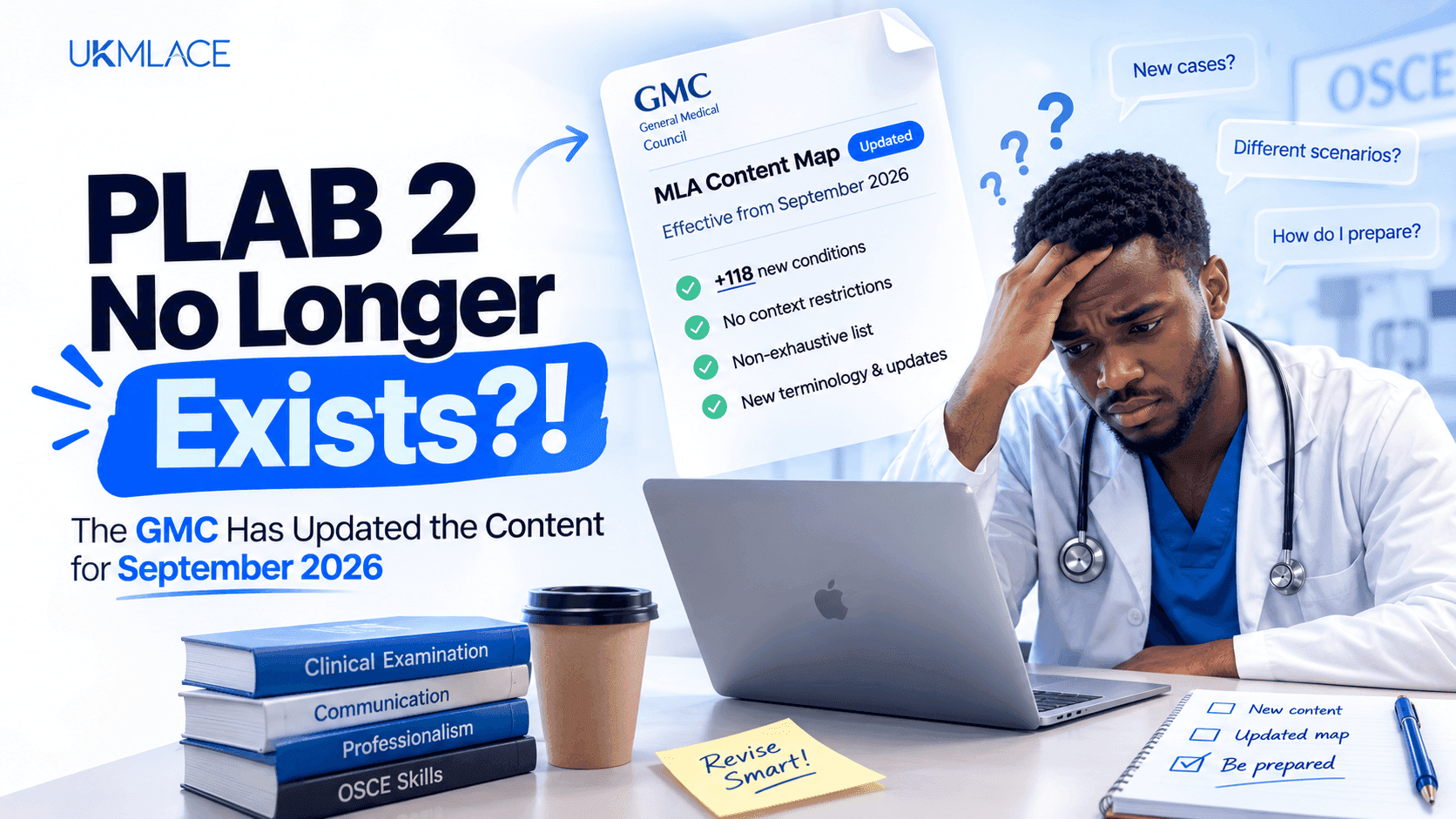
PLAB 2 No Longer Exists?!
Well... not exactly. But if your PLAB 2 is from September 2026 onwards, there is a much more important question you should be asking:
Is the PLAB 2 you are preparing for the same PLAB 2 your preparation resources were built for?
Because the answer may be no.
PLAB 2 has not disappeared. The GMC has not announced a replacement exam. PLAB is still called PLAB, and PLAB 2 remains the clinical and professional skills assessment (CPSA) for international medical graduates.
The GMC explicitly confirms that PLAB 2 meets the MLA CPSA requirements, and says PLAB will keep its current name for now. You can read the GMC's own content map documentation here: GMC MLA Content Map.
But from September 2026, PLAB assessments move onto the GMC's updated MLA content map.
And that update is substantial.
The previous content map remains the reference for assessments up to and including August 2026. The updated version applies to PLAB from:
September 2026
That date is the line. Sit before it, and the old framework is still your reference. Sit on or after it, and you are not preparing against exactly the same content framework as someone who sat before you.
That matters.
The part candidates should actually be worried about
The GMC has made several changes to the content map.
Not rumours.
Not Telegram speculation.
Not tutor predictions.
Published changes, and you can review them directly on the GMC's MLA content map page.
1. The conditions list has increased from 311 to 430
That's 119 additional conditions.
The GMC itself describes this as a refinement and expansion of the conditions list (GMC).
The GMC also makes clear that these additions are intended to be covered within the updated content map.
Now, this does not mean you suddenly need to memorise 119 completely unfamiliar diseases before your exam.
But it does mean something much more important for PLAB 2 candidates:
The framework used to construct the assessment has become broader.
If your preparation was created before this update, it was created before these additions existed in the current content map.
That doesn't automatically make an old resource useless.
It does mean you should stop assuming that because you have completed a popular station bank, you have automatically covered the current exam framework.
You may have covered the stations.
You may not have covered the updated framework.
Those are two different things.
2. The old context restrictions have been removed
This is potentially even more important.
The updated content map is designed around connections between conditions, presentations, clinical practice and professional capabilities rather than rigid classifications. The GMC's updated documentation specifically states that conditions can be assessed across different contexts and that the body-system categorisation should not be interpreted as a rigid classification (GMC).
What does that mean for preparation?
It means you should be much less comfortable with the idea that:
"I've learned this condition, so I know exactly what kind of station it will appear in."
You don't.
A familiar condition can be placed into a different clinical context.
A familiar presentation can lead you somewhere you weren't expecting.
And a station doesn't have to look like the version you've practised 20 times.
That is where candidates who rely heavily on memorised station scripts can become vulnerable.
The biggest change may be this sentence
The GMC has explicitly reframed the conditions list as indicative rather than exhaustive (GMC).
Read that again.
The list contains 430 conditions.
But the GMC is telling candidates not to treat those 430 conditions as a complete boundary around what they need to understand.
This is important because it moves preparation away from:
"I have finished the list."
towards:
"I understand how to reason through the clinical problem even when the presentation isn't exactly what I rehearsed."
That distinction matters enormously in a practical exam.
Could PLAB 2 have new cases from September 2026?
Given what's actually in the update, very plausibly, yes.
This isn't speculation dressed up as urgency. It follows directly from what changed:
- 119 additional named conditions means 119 things that could now legitimately appear in a station that weren't formally in scope before.
- The removed context restriction means conditions you've practised can now show up in settings your preparation never rehearsed them in.
- The "non-exhaustive" reframing means the GMC has explicitly told candidates not to treat any list, including this one, as the boundary of what can be tested. That doesn't mean every station you know becomes irrelevant, and it doesn't mean PLAB 2 has been redesigned from scratch. It means candidates sitting from September 2026 onward are working against a framework with more surface area and fewer guardrails on where a given case can be set than the one most existing prep material was built against.
And this is where September 2026 becomes uncomfortable
Imagine you have spent months practising the same stations.
You know the opening.
You know the expected questions.
You know the likely patient responses.
You know the counselling points.
You can almost predict what comes next.
Then you walk into the examination room.
The diagnosis isn't quite what you expected.
The patient is presenting in a different context.
The information is incomplete.
The scenario doesn't follow the sequence you memorised.
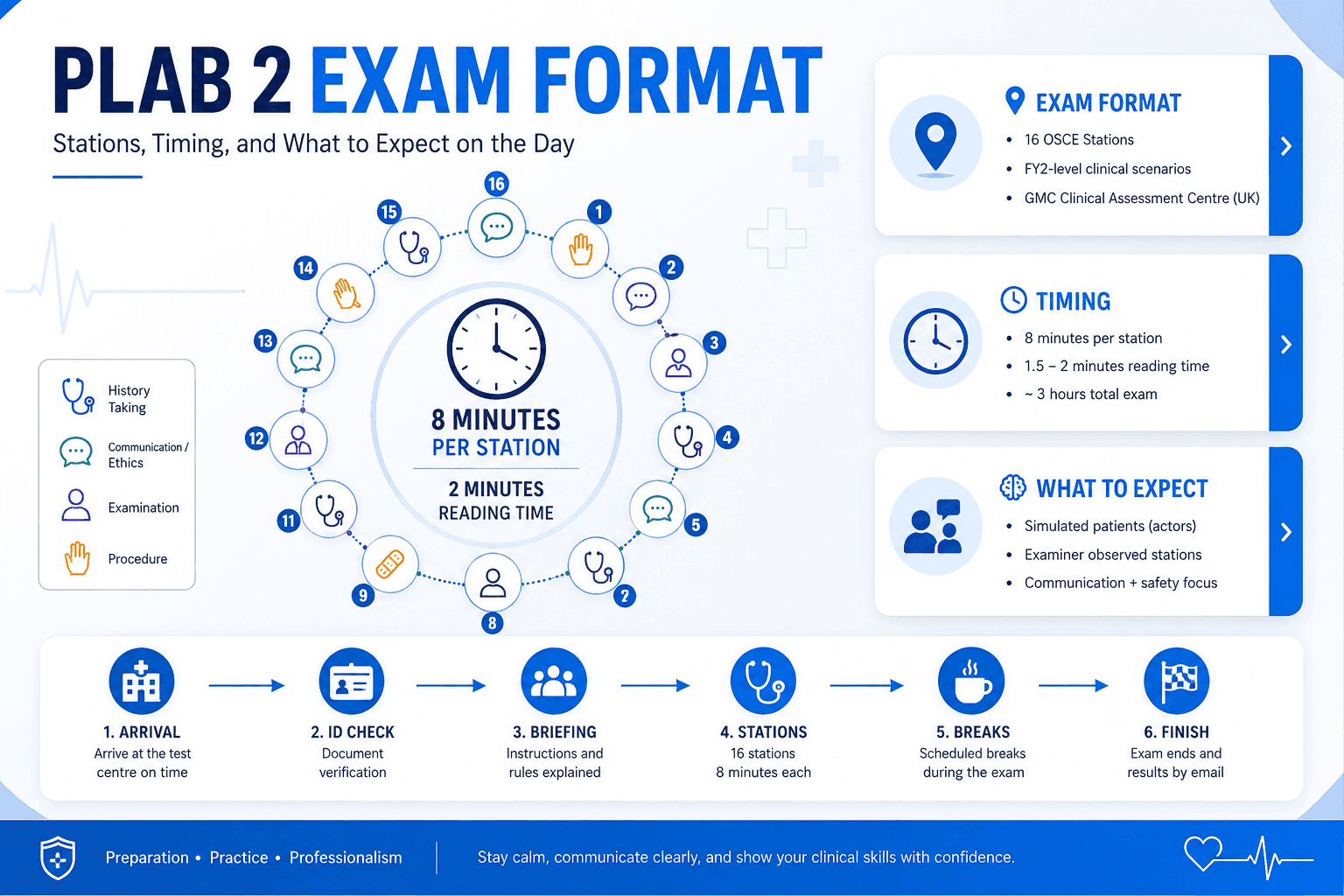
And you have eight minutes to work it out.
That is not necessarily a problem if your preparation has taught you how to think through the station.
It becomes a much bigger problem if your preparation has primarily taught you what to say when you recognise the station.
PLAB 2 is not designed simply to reward recall of scripts. The GMC describes it as a performance-based assessment of clinical and professional skills, knowledge and behaviours, with candidates assessed on data gathering, clinical management and interpersonal skills (GMC).
So the real question for September 2026 candidates isn't:
"How many stations have I memorised?"
It is:
"What happens when I get a station I haven't seen before?"
Don't confuse familiarity with preparedness
This may be one of the most dangerous traps in PLAB 2 preparation.
You practise a station five times.
You practise it again.
Then again.
Eventually, you can perform it almost automatically.
That feels like progress.
And it is, to a point.
Repetition is useful.
But there is a difference between recognising a station and being able to manage a clinical scenario.
The first skill helps when the station looks familiar.
The second helps when it doesn't.
And with the updated content map, candidates sitting from September 2026 onwards have more reason than ever to prepare for the second situation.
The GMC itself describes the updated content map as a framework intended to support clinical reasoning and managing uncertainty, rather than simply acting as a checklist for rote learning (GMC).
So what happens to all your existing PLAB 2 resources?
This is where you need to be careful.
Don't throw everything away.
Your existing resources may still contain excellent stations.
Communication skills still matter.
Clinical management still matters.
Professionalism still matters.
Patient-centred communication still matters.
The fundamental PLAB 2 skills have not suddenly disappeared.
But ask yourself:
When was the resource you are relying on created?
If it was created before the updated content map was published, it could not have been built specifically around the September 2026 framework.
That's not necessarily a criticism of that resource.
It's simply a question of currency.
A resource can be excellent and still be outdated.
A textbook can be excellent and still contain an old guideline.
A station bank can be excellent and still reflect the framework that existed when it was created.
The danger is assuming that good automatically means current.
It doesn't.
September 2026 candidates have a different preparation problem
If you are sitting PLAB 2 before September 2026, the previous content map remains the reference for your assessment.
But if you are sitting from September 2026 onwards, the updated map applies (GMC).
That means your preparation should account for:
- 430 conditions rather than 311
- 119 newly added conditions
- A conditions list that is now explicitly indicative rather than exhaustive
- Greater emphasis on connections between presentations, conditions and clinical contexts
- Updated terminology and categorisation
- Greater emphasis on managing uncertainty
- The fact that conditions should not be treated as belonging exclusively to one clinical setting And this creates a very uncomfortable question:
How confident are you that your current station bank has kept up?
Not how popular it is.
Not how many students have used it.
Not how many stations it contains.
How closely does it reflect the framework that applies to your exam?
This is exactly why we built UKMLACE
We don't believe PLAB 2 preparation should be a static collection of stations that gets created once and then left unchanged.
The exam framework changes.
Preparation needs to change with it.
UKMLACE is an online PLAB 2 preparation platform built around interactive practice rather than simply giving candidates another PDF or static station collection.
We are actively reviewing our material against the September 2026 MLA content map, including the expanded conditions framework and the way the updated map connects conditions, presentations and clinical contexts.
UKMLACE currently includes:
- Interactive PLAB 2 stations
- Updated content-map coverage
- Prescription practice
- Clinical simulations
- SimMan-style scenarios
- Station scoring and performance tracking
- Coverage tracking across OSCE domains and categories
- Examiner-focused marking guidance
- Peer-to-peer practice
- AI-simulated practice
- A dashboard to identify areas where your preparation is still weak The objective isn't to convince you that you need to memorise hundreds of new diseases.
It's the opposite.
We want you to be able to walk into a station you haven't memorised and still know what to do.
Don't prepare for yesterday's PLAB 2
PLAB 2 isn't disappearing.
But the framework behind it is changing.
The GMC has expanded the conditions list from 311 to 430, explicitly made the list non-exhaustive, and updated how the content is structured and connected. You can verify all of this directly on the GMC's MLA content map page.
That doesn't mean every old PLAB 2 resource suddenly becomes useless.
It means something more subtle, and more important:
You can no longer assume that an old resource is sufficient simply because it has helped candidates pass in the past.
If your exam is from September 2026 onwards, your preparation should reflect the framework that applies to your exam.
Because the biggest risk isn't walking into PLAB 2 knowing nothing.
It's walking in believing you're fully prepared because you've practised hundreds of familiar stations...
...and discovering that the station in front of you isn't one of them.
Prepare for the station you haven't seen.
Prepare with UKMLACE.
Start your PLAB 2 preparation → UKMLACE
.png&w=3840&q=75)