
If you are an international medical graduate planning to work in the UK, you have almost certainly come across the term PLAB 2. It is the part of the journey most candidates feel the least prepared for, mainly because it tests something medical school rarely grades directly: how you actually behave in front of a patient.
PLAB 2 in One Sentence
PLAB 2 is the practical, clinical skills half of the PLAB test — the licensing exam that international medical graduates must pass to register with the GMC and work as a doctor in the UK. Officially, it is called the Clinical and Professional Skills Assessment, but almost everyone still refers to it by its older name.
Where PLAB 1 checks what you know, PLAB 2 checks what you do with it.
What Kind of Exam Is It?
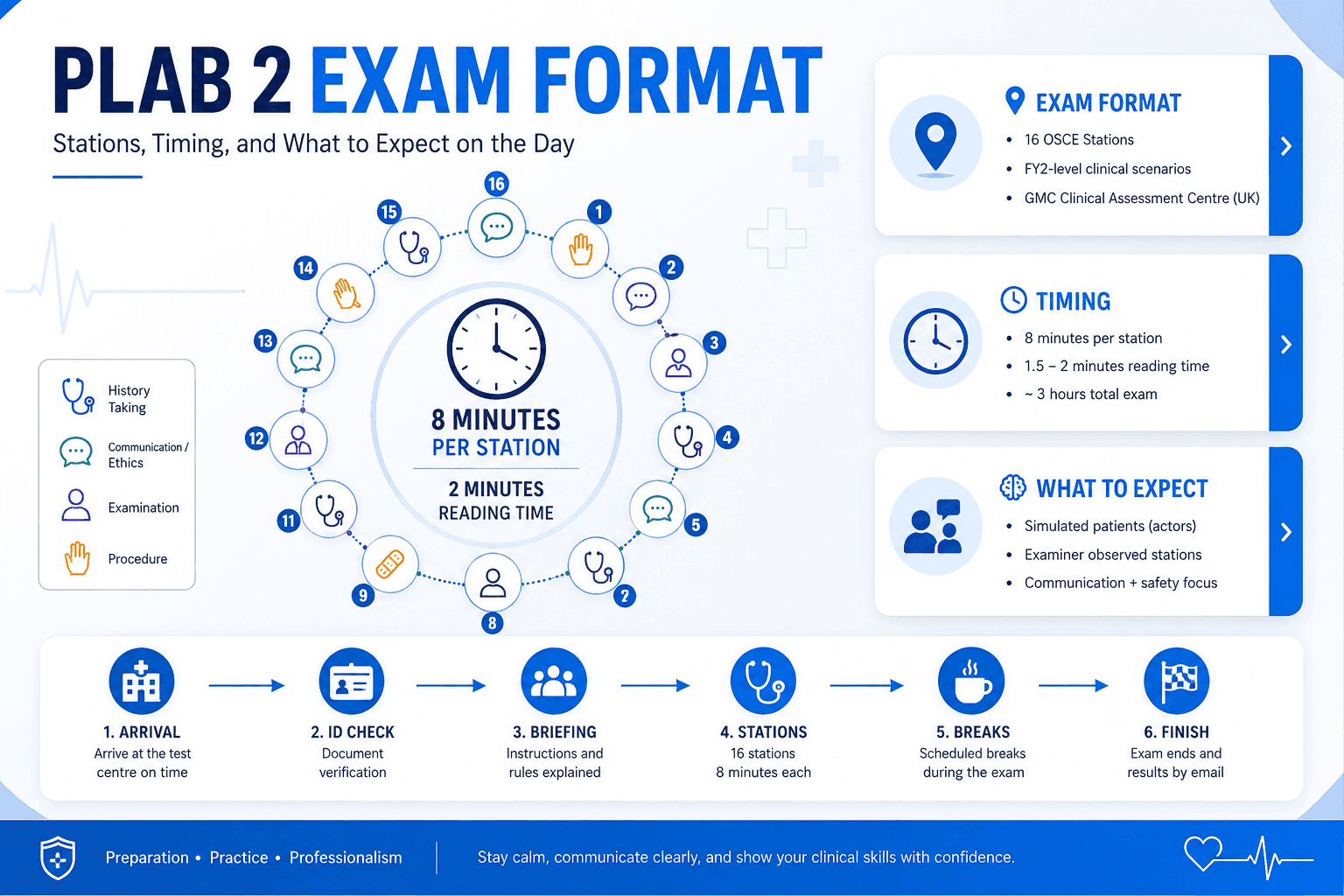
PLAB 2 is an Objective Structured Clinical Examination, commonly shortened to OSCE. It's a performance-based assessment of clinical and professional skills, knowledge and behaviours, made up of 16 scenarios, each lasting eight minutes, designed to reflect real life settings such as a mock consultation or an acute ward.
In practice, this means you move through a circuit of consultation rooms, each containing a different scenario. The exam consists of 16 clinical stations plus 2 rest stations, with each clinical station lasting 8 minutes and preceded by roughly 1.5 minutes to move between rooms and read the instructions outside the door.
At each station, you are interacting with a simulated patient — a trained actor playing a role — rather than a real one. Some stations use a manikin for an examination or procedure instead.
What Level Is It Testing?
This is the detail most candidates underestimate. PLAB 2 is not testing specialist knowledge. The exam could cover anything a doctor appointed to a Foundation Programme Year 2 role might expect to see at work, testing clinical knowledge, skills and behaviours, and the ability to apply that knowledge to patient care — not how well facts can be recited.
That last part matters more than it sounds. You are not being asked to prove you remember a guideline. You are being asked to prove you can run a safe, structured consultation under time pressure, the same way you would on a ward in your second year as a UK doctor.
Where Does It Sit in the GMC Pathway?
PLAB 2 cannot be booked in isolation. You need to pass PLAB 1 first — the 180-question written exam — before PLAB 2 becomes available on your GMC account. Once you pass PLAB 2, you can apply for registration with a licence to practise, and that application needs to go in within two years of your pass.
PLAB 2 is also where the exam becomes geographically fixed: unlike PLAB 1, which runs at international test centres, PLAB 2 is held only in Manchester, UK. For most candidates, that means travel and accommodation become part of the preparation logistics, not just the studying.
How Is It Marked?
Each station is scored independently against three domains of roughly equal weight: data gathering and clinical examination, communication and interpersonal skills, and clinical management. A strong performance in one domain does not offset a weak one elsewhere, and consistency across stations matters more than having one or two standout performances.
The pass mark is not fixed in advance. It is set in relation to how the cohort performs on the day, and you also need to pass a minimum number of individual stations rather than just hitting an overall average. This is one of the reasons a single difficult station should not derail your performance in the ones that follow — the exam is designed to be recoverable from a bad eight minutes, provided the rest of the circuit holds up.
How Does PLAB 2 Relate to the UKMLA?
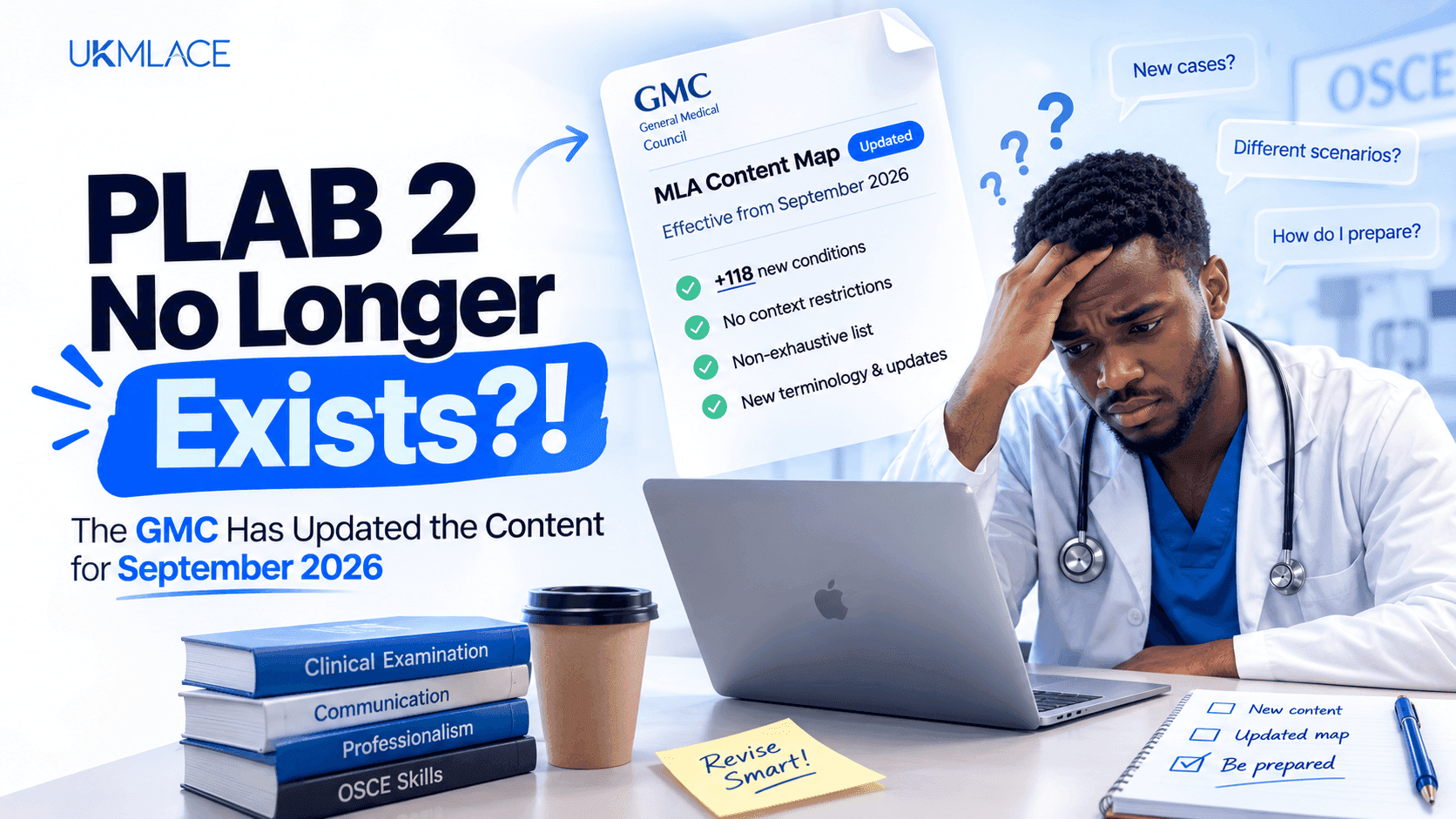
You may also see PLAB 2 referred to alongside the UKMLA, the Medical Licensing Assessment the GMC introduced to set one common standard for all doctors registering to practise in the UK, whether they trained domestically or overseas. PLAB is now compliant with the MLA requirements, with the questions and stations used in PLAB based on the MLA content map — the document that sets out the core knowledge, skills, and behaviours expected for UK practice.
In practical terms, this does not mean a new or separate exam exists for IMGs. PLAB 1 remains a computer-based exam and PLAB 2 remains an OSCE, with the administrative pathway unchanged — IMGs still book through the GMC portal and still sit PLAB 2 in Manchester. What has changed is the breadth of content the exam can now legitimately draw from, which is exactly why preparation material needs to be current rather than several years old.
What This Means for Preparation
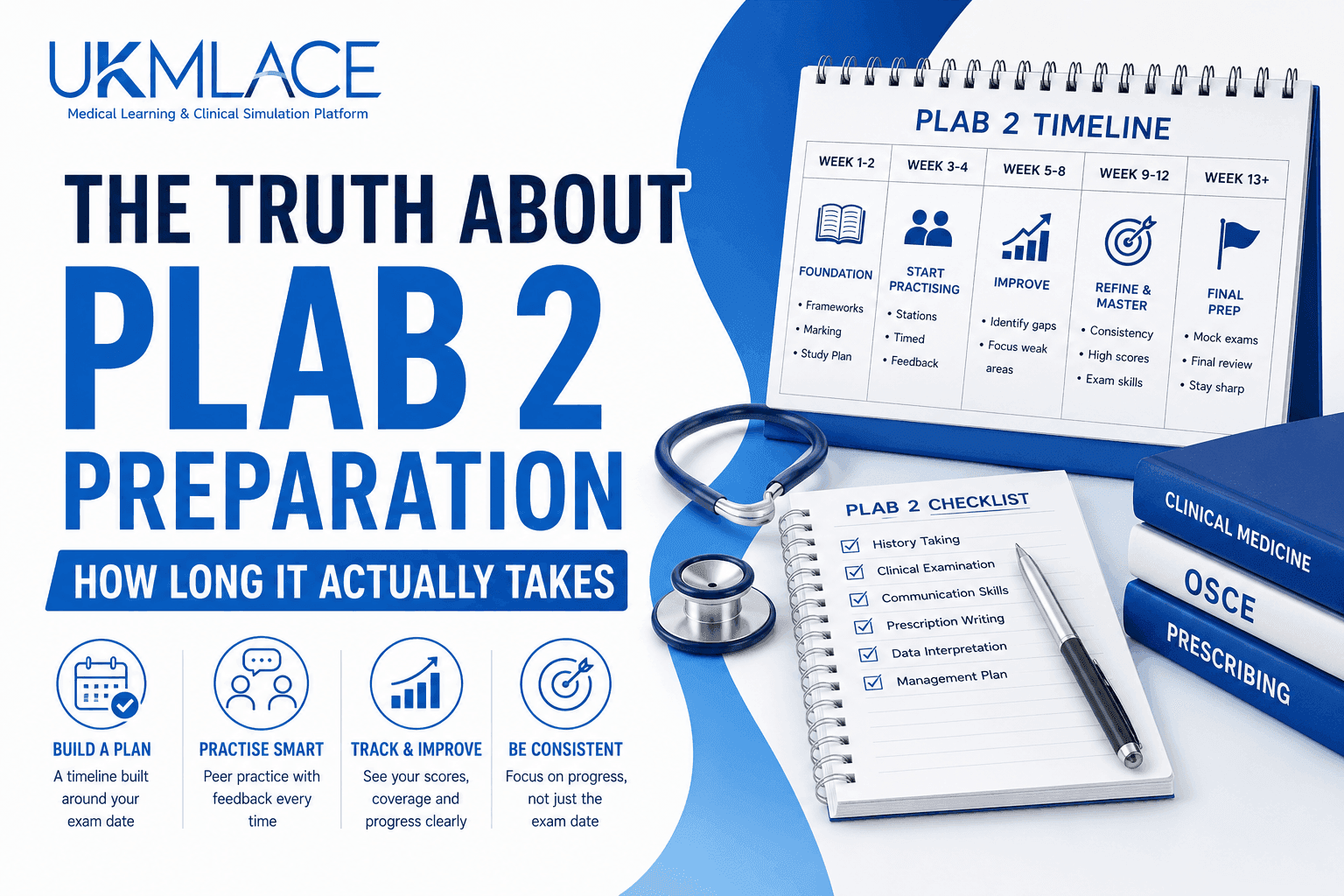
Because PLAB 2 tests applied behaviour rather than recall, reading alone will only take you so far. The skills it is built to assess — structuring a consultation, examining a patient appropriately, explaining a diagnosis clearly, safety-netting before the consultation ends — only sharpen through repetition under timed, observed conditions, ideally with someone giving you honest feedback afterwards.
This is the gap most self-study misses, and it is also where having a clear sense of your own performance across every domain becomes useful early — not just in the final weeks before your exam date.
Once you understand what PLAB 2 is, the next logical question is what the exam actually looks like on the day — station types, timing, and what examiners are watching for. UKMLACE brings structured notes built around PLAB 2 marking criteria, peer-to-peer practice with a live timer, AI stations available any time, and analytics that track your score across every OSCE domain — so your preparation is built around the exam you are actually sitting.
.png&w=3840&q=75)