.png&w=3840&q=75)
PLAB 2 has a way of humbling candidates who came in confident. The truth most people don't hear early enough is that failure rarely comes down to medical knowledge. The doctors sitting that exam are qualified, they've studied, they know their differentials. What undoes them is execution, the gap between knowing something and actually demonstrating it under timed, observed pressure.
Poor Preparation
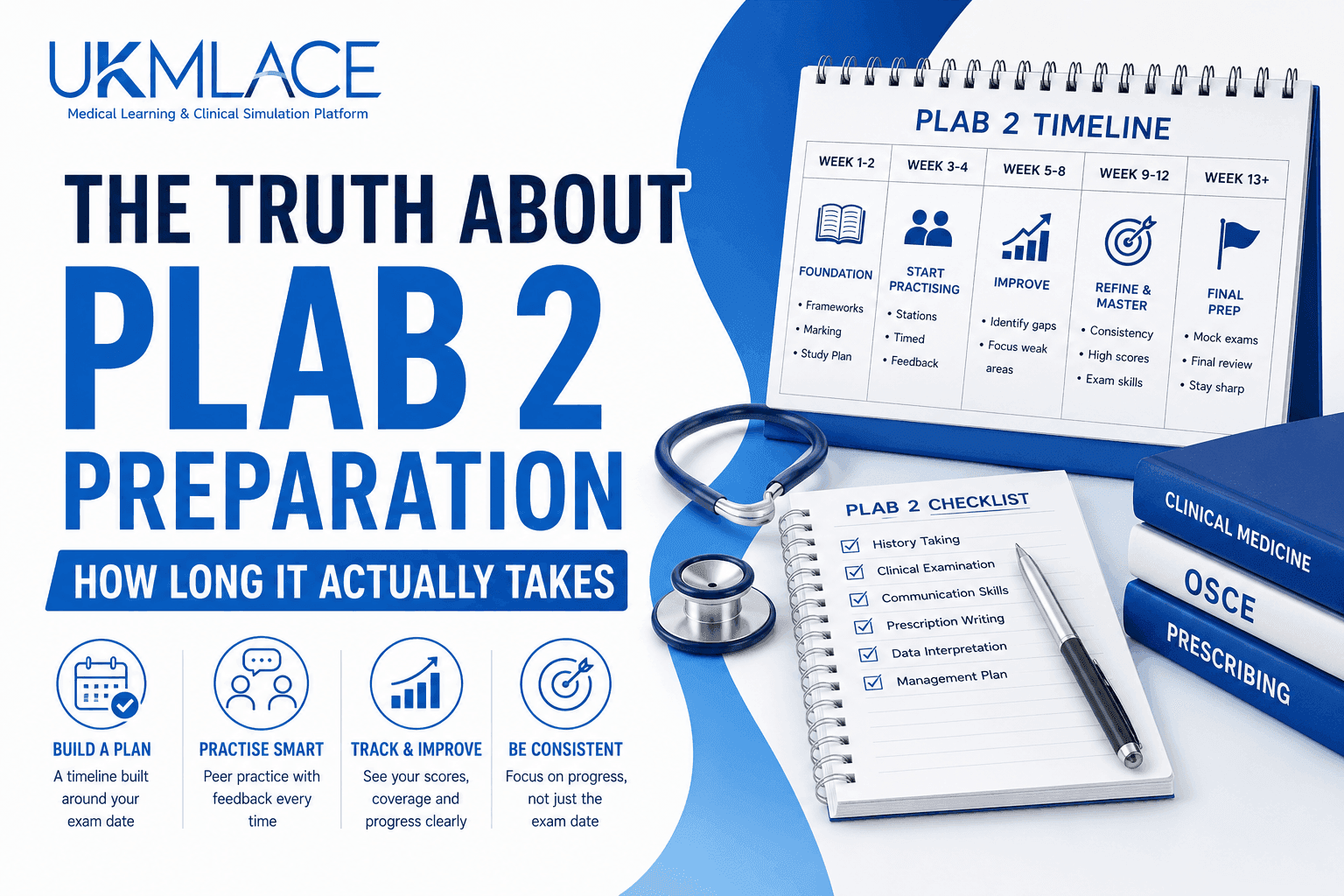
Balancing work and studying is a reality for most PLAB 2 candidates, and it makes structured preparation genuinely difficult. The honest answer is that there is no single timeline that guarantees a pass, but 3 to 4 months of active preparation is the sweet spot for most candidates. Anything less, without prior OSCE experience or ongoing clinical practice in the UK, and the pass rate drops noticeably.
Active preparation doesn't mean reading alone. It means timed stations, real feedback, and tracking progress across every domain, data gathering, interpersonal skills, and clinical management, so you know where your marks are actually going. Tools that let you monitor this across sessions remove a lot of the guesswork and help you spend revision time where it genuinely moves the needle.
Information Overload From the Wrong Resources
One of the quieter causes of failure is this: candidates drown in material that has nothing to do with what PLAB 2 actually tests. There are a lot of resources out there, and many of them are comprehensive in ways that are actively unhelpful, loading candidates with differentials, drug doses, and clinical detail that the exam simply does not require.
PLAB 2 tests communication, structure, safety, and clinical reasoning at the level of a foundation doctor. The notes you study from should reflect the actual marking criteria and NICE guidelines that examiners use, organised by station type and system, not by medical encyclopaedia logic. When revision material is built around what the examiner is looking for, preparation becomes faster and more focused.
Poor Consultation Structure
Without a clear opening and a reliable framework to return to, stations become disjointed. The candidate asks questions in whatever order they occur to them, misses entire domains, and leaves the examiner with no sense that this is a doctor they would trust to run a consultation independently.
The fix is not complicated. It is a repeatable structure drilled until it becomes instinct: open warmly, set an agenda, take a focused history, summarise, signpost. Every station, every time, without thinking. GRIPS — Greeting, Rapport, Introduction, Purpose, Smile, is one such framework, and candidates who have internalised it consistently outperform those who improvise their openings.
Being Too Scripted
Here is the flip side of structure: some candidates over-correct and turn their framework into a performance. They hit every heading on the mental checklist, but they stop listening. The patient says something unexpected and the candidate ploughs straight past it into the next pre-planned question.
Examiners notice this immediately. A script is a scaffold, not a script. The structure should feel invisible to the patient. What they should experience is a doctor who is genuinely present, responding to what they actually say, adapting in real time. Practising in conditions where someone can interrupt, go off-piste, or give unexpected answers is how you build that flexibility, not reading stations alone.
Missing Safety-Netting
Candidates will give reasonable advice and then simply stop, as though the consultation ends when the diagnosis is named. It doesn't. Real clinical communication means telling the patient what to watch for, what should bring them back urgently, and when you expect to review them, then checking they have actually understood. Examiners notice immediately when this is missing, and they notice when it is present.
Weak Communication Under Stress
Under pressure, pace quickens, sentences grow complicated, and empathy gets compressed into a single "I understand that must be difficult" near the end. Patients in PLAB 2 stations are looking for a doctor who sounds calm and human, not one reciting a checklist. Slowing down deliberately, using plain language, and showing warmth from the very first exchange makes an enormous difference to how the station feels to an examiner.
This is something that only improves with observed practice. Reading about communication is not the same as doing it under a timer with someone watching. The more realistic the practice conditions, real time pressure, a live patient actor or AI, feedback immediately after, the faster the improvement transfers to the actual exam.
Incomplete Examination and Management
Knowing the diagnosis privately is not the same as presenting it clearly and safely. A good plan names the likely diagnosis, acknowledges differentials, explains what happens next in concrete terms, and includes escalation where appropriate. Candidates who skip over any of these, even when they knew the answer — hand marks back unnecessarily.
Prescription stations catch a surprising number of candidates off guard for the same reason. Knowing what to prescribe and writing a correct prescription on paper under time pressure are different skills. Consistent practice with the actual format matters.
Lack of Deliberate Practice
Many candidates do a large number of stations and do not improve, because volume without feedback is just rehearsing mistakes. Deliberate practice means timed conditions, honest review of what went wrong, and returning to weak domains until the performance is consistent — not just until it feels comfortable.
This is where peer practice becomes genuinely valuable. Practising with another candidate who gives real-time feedback, under actual time pressure, exposes things that self-review never catches. The same applies to AI-assisted practice: done well, it gives candidates the repetitions they need at any hour, and the ability to flag exactly where marks were dropped.
The most useful question after every station is not "did I pass?" but "which domain did I lose marks in, and why?" Tracking that data across sessions is what turns practice into progress.
The Final Takeaway
Most PLAB 2 failures are genuinely fixable. The exam rewards structure, clarity, and self-awareness more than brilliance. Train the way the exam actually tests you — timed, observed, with feedback after every session, and with resources built around what examiners actually mark. The patterns that cause failure start to disappear.
Preparing for PLAB 2? UKMLACE is built specifically around how the exam is marked — peer-to-peer practice with a live timer, AI stations available around the clock, prescription practice without printing anything, score tracking across every OSCE domain, and structured notes tied directly to NICE guidelines and PLAB 2 marking criteria. Everything in one place, built for the exam you are actually sitting.