
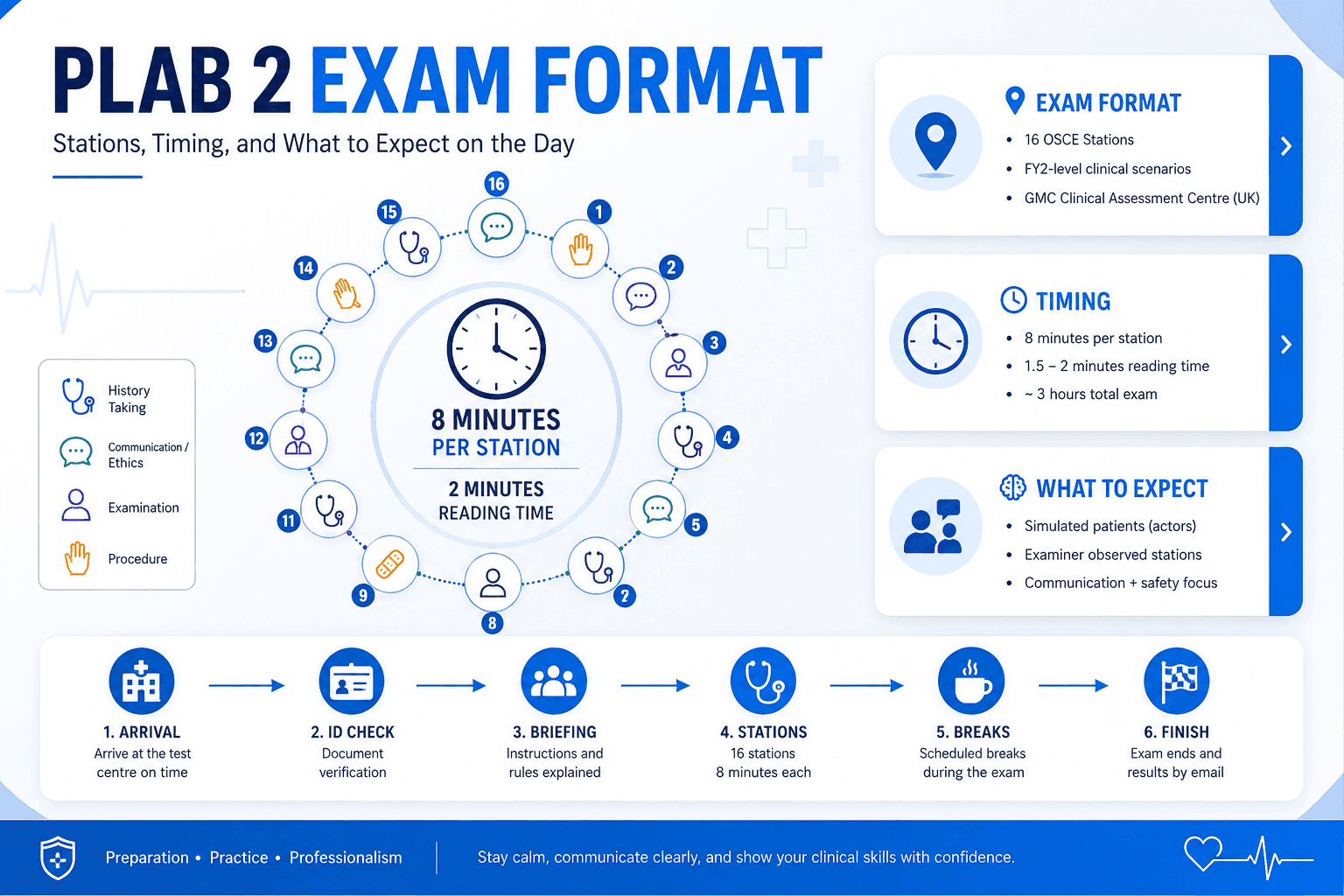
Knowing the medicine is one thing. Knowing exactly what the day itself looks like — how the rooms are arranged, how much time you actually get, what happens between stations — removes a surprising amount of avoidable stress. Here is the format, in the order you will actually experience it.
The Basic Structure
PLAB 2 is an Objective Structured Clinical Examination made up of 16 scenarios, each lasting eight minutes, designed to reflect real-life clinical settings such as a mock consultation or an acute ward. You move through a circuit of rooms in a fixed sequence, spending eight minutes in each one before a bell signals the move to the next station.
Most circuits also build in a small number of rest stations, giving you a short pause partway through rather than 16 consecutive scenarios back to back.
Timing, Station by Station
Before each station, you are given a short reading period — typically around 1.5 minutes — to read the instructions and patient information posted outside the door before you go in. This is where you find out who you are seeing, what the presenting complaint is, and what task you are being asked to complete: take a history, perform an examination, deliver a result, write a prescription, or some combination of these.
Once inside, the eight-minute clock starts. At the start of each station, you are typically asked to confirm your name and GMC number, after which you move into the scenario itself with a simulated patient — an actor trained to respond consistently across every candidate they see that day.
When the bell goes, the station ends regardless of where you are in the consultation. There is no extension, and there is no going back.
What the Stations Actually Cover
The scenarios are designed to reflect the full range of situations a Foundation Year 2 doctor might encounter, not a narrow slice of medicine. Across a sitting, you can expect a mix of:
- History-taking stations — gathering a focused history from a patient with a specific presenting complaint
- Examination stations — performing a relevant focused examination, sometimes on a manikin
- Management and explanation stations — discussing a diagnosis, a plan, or a procedure with a patient or relative
- Communication and ethics stations — handling a difficult conversation, a complaint, or a consent discussion
- Practical or data-interpretation stations — prescribing, interpreting a result, or acting on an investigation
Many stations combine more than one of these in a single eight minutes, which is exactly why pacing and structure matter as much as clinical knowledge.
How Marking Works
Each station is scored independently across three domains, generally treated as equally weighted: data gathering and clinical/technical skills, communication and interpersonal skills, and clinical management. A strong showing in one domain will not compensate for a weak one in the same station — examiners are looking for competence across all three, not brilliance in one.
The overall pass mark is not fixed year to year; it is calculated based on the performance of the cohort sitting on that occasion. You also need to pass a minimum number of individual stations, not simply average out across all 16. In practice, this means one difficult station does not need to define your exam — the format is built so that a single weak performance can still sit within an overall pass, provided the rest of the circuit is solid.
On the Day, in Manchester
PLAB 2 is held exclusively at the GMC's clinical assessment centre in Manchester. After arriving and having your booking confirmation and passport checked, you are given a locker for your belongings — phones, watches, bags, and notes all stay outside the circuit, since nothing can be taken into the exam rooms.
You then receive a short briefing covering the rules and the layout of the circuit before being assigned a starting station. From that point, the exam runs on a fixed schedule: move, read, perform, bell, move again, all the way through the 16 stations.
Results are typically published within about a month of the exam date.
What the Format Actually Rewards
Once you see the structure laid out like this, the implications for preparation become fairly obvious. Eight minutes is not long enough to recover from a disorganised opening. A reading period of 90 seconds is not long enough to plan a strategy you haven't already drilled. And three independent marking domains mean a station cannot be "passed" on knowledge alone if the communication or the management plan falls short.
This is why timed, observed practice matters so much more here than in written exams — the format itself is the thing being tested, not just the medicine sitting inside it.
Practising against this exact structure — eight-minute stations, a live timer, and feedback broken down by domain — is the fastest way to get comfortable with the format before exam day. UKMLACE replicates the real timing with peer-to-peer practice and AI stations available any time, and tracks your performance across data gathering, communication, and clinical management so you can see exactly where the format is still catching you out.


.png&w=3840&q=75)